Jetour has introduced the T1 and T2 plug-in hybrid models to Mzansi. Here’s how much the new-energy variants cost…
Signifying an important step for Jetour in South Africa, the Chinese marque has introduced plug-in hybrid (PHEV) variants of its popular T1 and T2 models to Mzansi. Meet the T1 i-DM and T2 i-DM.
The internal combustion engine (ICE) component of the T1 i-DM and T2 i-DM’s PHEV powertrains come in the shape of a 100 kW/220 N.m 1.5-litre, four-cylinder turbocharged petrol — the latter coupled with a single and twin electric motors in the former and latter, respectively. The new-energy T1 and T2 produce combined power and torque outputs of 250 kW/530 N.m and 265 kW/610 N.m, respectively. Power is exclusively delivered to the road via the front wheels.
An 18.4 kWh battery pack is employed across the board. According to Jetour, a single, full charge offers operating ranges of 100 km and 90 km in the T1 i-DM and T2 i-DM, respectively. The company claims a combined driving range of 1 200 km for both models.
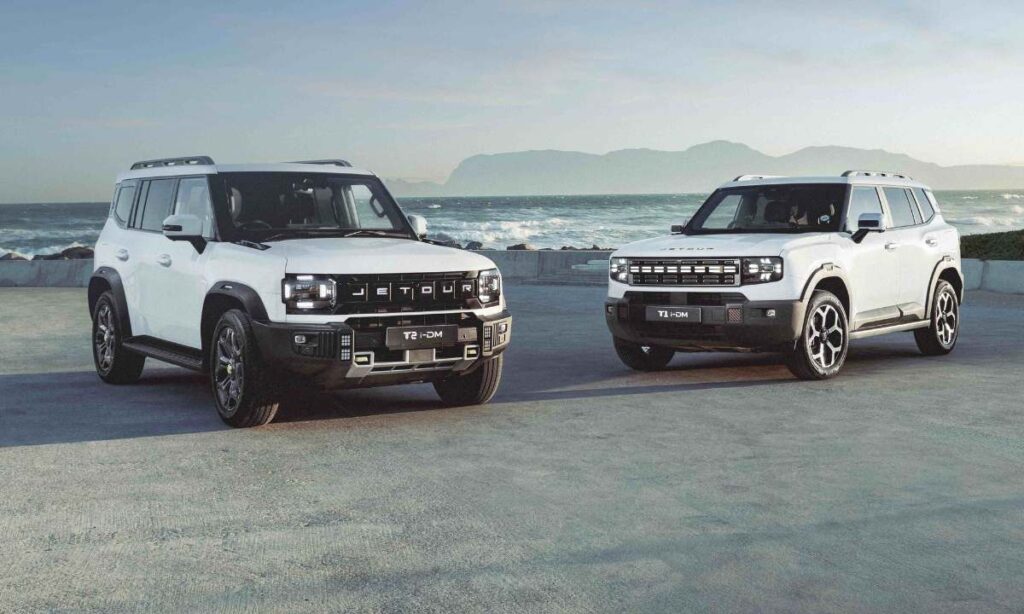
How much does the Jetour T1 i-DM PHEV cost in South Africa?
The Jetour T1 i-DM PHEV is priced from R689 900. Included with the package as standard are a seven-year/200 000 km vehicle warranty, eight-year/160 000 km battery warranty and a seven-year/75 000 km service plan. A 10-year/1 million km engine warranty (for the first owner) is also included.
How much does the Jetour T2 i-DM PHEV cost in South Africa?
The Jetour T2 i-DM PHEV is priced from R779 900. Pricing for the new-energy T2 includes the same seven-year/200 000 km vehicle and eight-year/160 000 km battery warranties, and seven-year/75 000 km service plan as T1 i-DM. First owners also benefit from a 10-year/1 million km engine warranty.
“The introduction of our PHEV models is an important strategic step for Jetour as we continue to balance sustainable mobility with meaningful user value,” says Nic Campbell, Vice President of Jetour South Africa. “From an environmental perspective, these vehicles help reduce carbon emissions, aligning with the global shift toward greener development. At the same time, in a market where energy costs continue to fluctuate, PHEVs offer real practical benefit by lowering fuel consumption and helping users reduce their day-to-day running costs”.