Kelly Fisher calls this a “brave but bumpy debut.” Let’s have a closer look
There’s something admirable about a company like Tata, a brand that, against all odds, keeps trying to find its place in South Africa’s crowded market. I was impressed with the Harrier when we had it a few weeks ago, so I was eager to see what the Tiago had in store for us when it arrived.
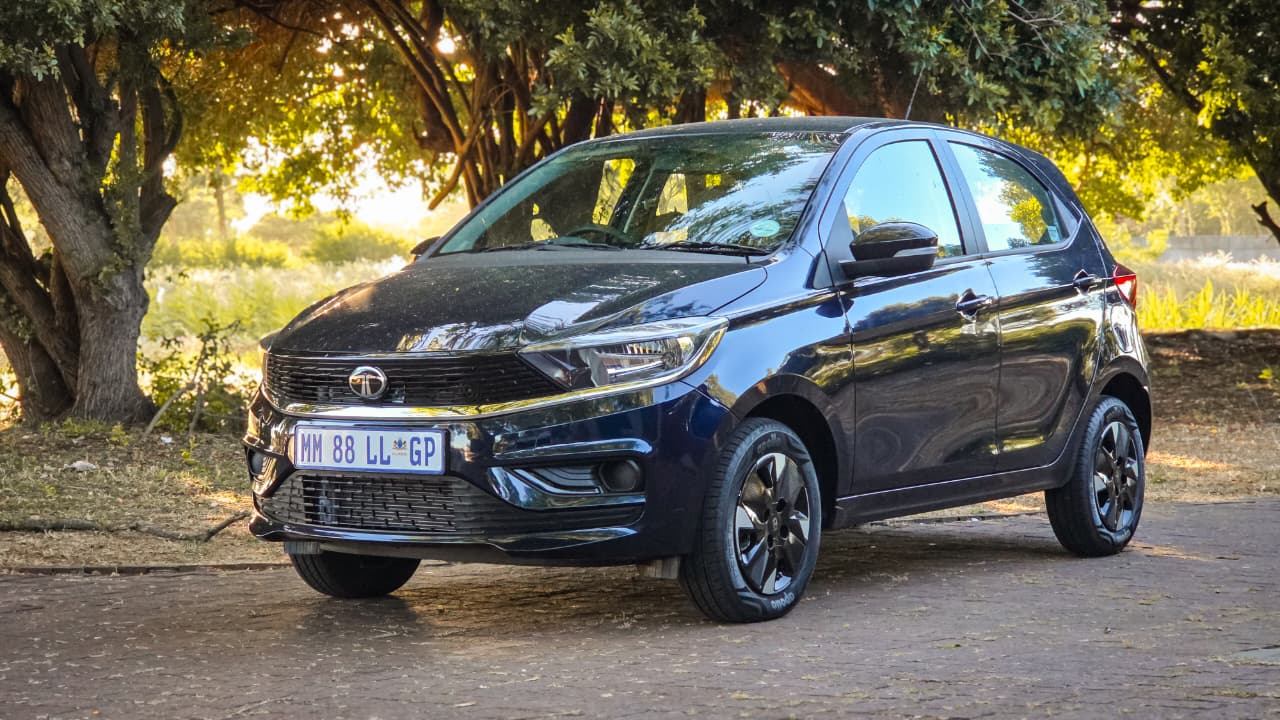
On paper, it’s a value proposition that’s hard to argue with. It’s a brand-new hatchback for under R200,000, complete with a reverse camera, touchscreen infotainment, and a five-year/125 000 km warranty. In a world where “affordable” cars are edging frighteningly close to R300,000, the Tiago seems like a good buy. But every time I step into a pocket-friendly car, I ask myself: “Would I recommend this to a loved one?” The answer this time is quite simply no. Let’s get the stats out of the way before I share my thoughts. Under the bonnet lies a naturally-aspirated 1.2-litre three-cylinder petrol engine (1199 cc) delivering 63 kW of power and 113 Nm of torque (at about 3 300 rpm). It is paired with a 5-
speed manual or a 5-speed automated manual transmission (AMT) for the AMT variant. The claimed fuel consumption is around 5.0 L/100 km and the fuel tank holds 35 litres.
It’s priced as follows in South Africa at launch:
● 1.2 XM 5MT: R184 900
● 1.2 XT 5MT: R209 900
● 1.2 XT AMT: R224 900
The first thing you notice when you open the door isn’t the smell of new-car leather, it’s the unmistakable scent of hard plastic. It’s how Chinese cars would smell a decade or so ago. Everywhere you look, the cabin is a festival of grey and grainy textures. This might seem harsh, but the centre console, in particular, feels as if it’s been 3D-printed. The plastics creak when you press them, the knobs feel fragile, and the overall impression is one of cost-cutting that’s just a little too obvious.
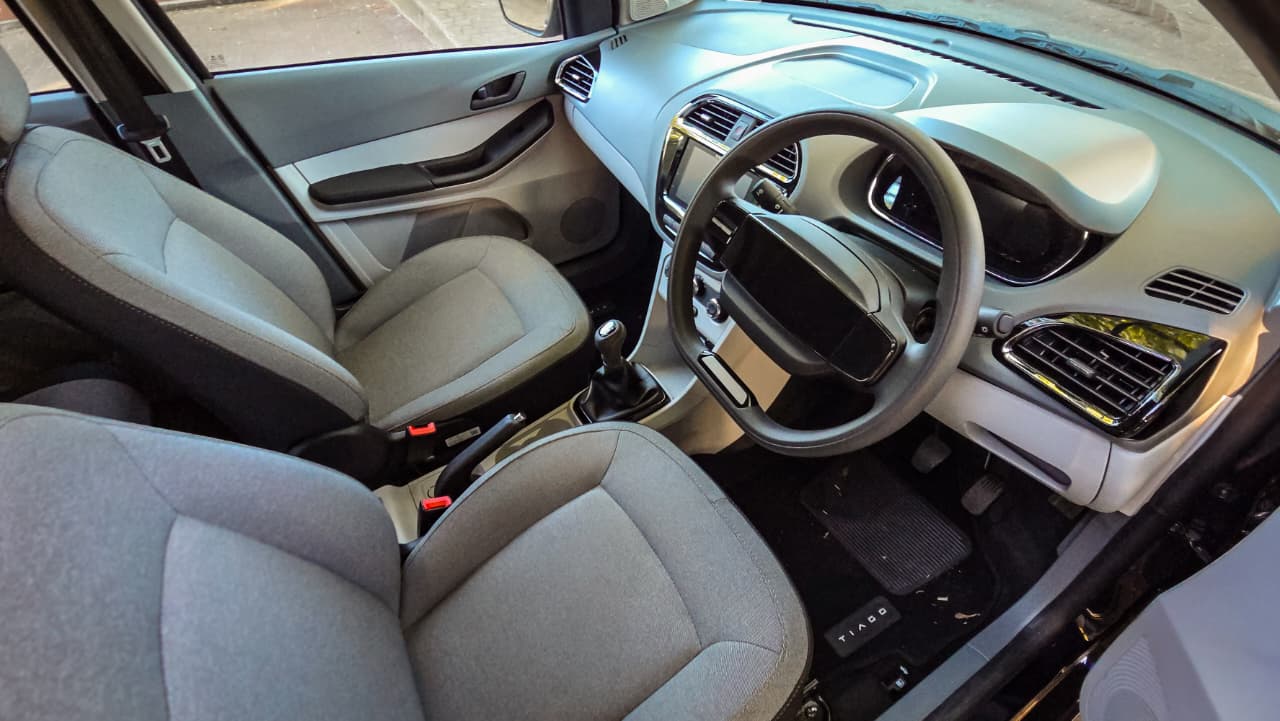
Tata’s design team has made an effort, though. The steering wheel is surprisingly modern, and the exterior is kind of sleek. The infotainment system, too, is a nice touch in a car at this price bracket with the XT trim bringing a 7.0-inch touchscreen with Apple CarPlay and Android Auto, plus a reverse-view camera into the mix. Out on the road, I did not like it even though the little engine does its best to keep up with traffic. It’s buzzy but eager, and for city driving it’s competent enough. The clutch is light, the steering easy, and visibility is good. But refinement isn’t its strong suit. It feels unrefined. I also found that when driving on the highway at over 100 km/h, there’s an odd squeak that comes through. I don’t know if it’s the wind over the side mirrors or if it’s a window or a door. Whatever it was, it
was a bit unnerving.
Let’s look at the competition:
● The Suzuki Celerio starts from R188 900 and goes up to R225 900 for the auto version. Its sibling, the Spresso, starts even lower at R179 800. Both are powered by a 1.0-litre engine.
● The Hyundai Grand i10 sits at the top of the price bracket and is listed from around R224 900 upwards. The engine output in the entry version is quoted at around 48.5kW/94 Nm for a 1.0-litre three-cylinder, or 61 kW/114 Nm for the 1.2-litre version.
● The Kia Picanto, meanwhile, is quoted as starting from around R236 995, and is equipped with a 1,0-litre that pushes out 45 kW and 95 N.m
All of the above feel like a better and more capable vehicle than the Tiago, although I’ll admit that the Tiago is probably bigger than its competitors.
In short: if you’re shopping for a new small hatchback around the R180k–R230k range, the Tiago can be in the mix, but I would most likely first recommend some of its nearest competitors. Value is not just about price and engine specs. It’s about the whole experience: the materials, the finish, the brand reliability, the feel of quality. The Celerio and Grand i10 may cost a bit more (or overlap in price) but their cabins feel more finished. The brand networks are well established. The Tiago, though bold in its pricing, feels like it asks you to compromise, not just
the price, but a nice chunk of feel-good quality and luxury of touch.
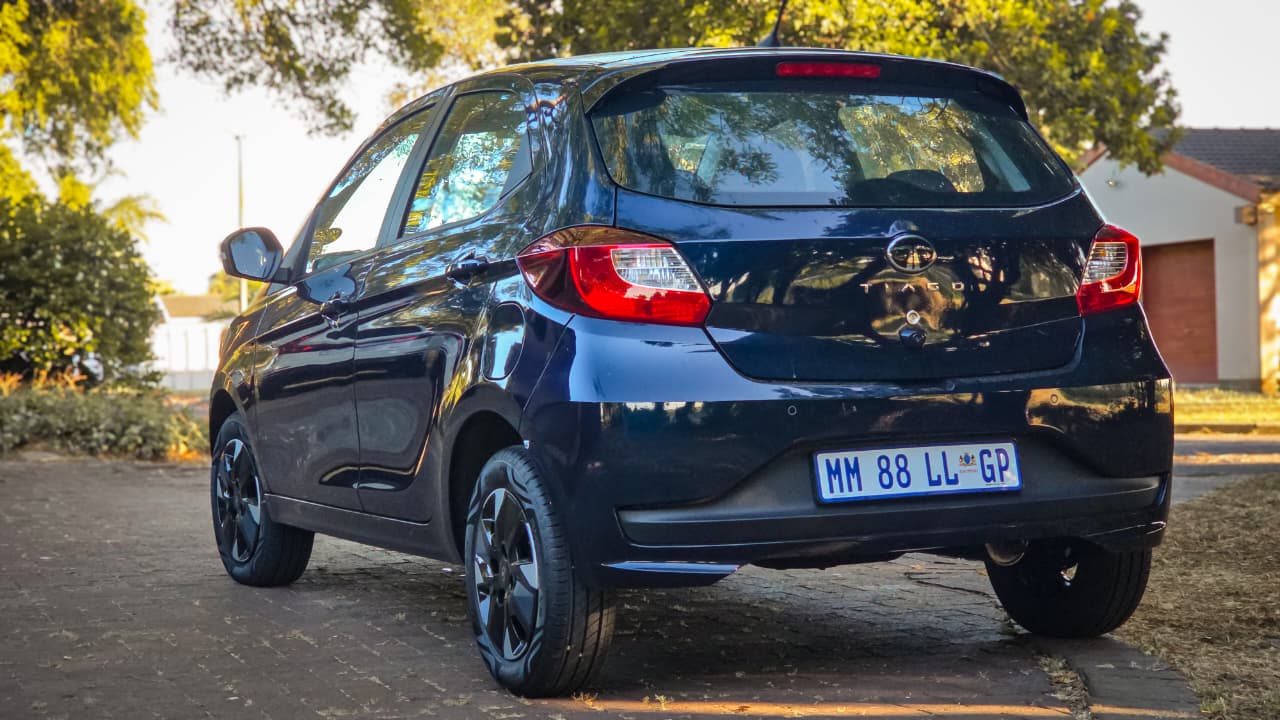
The market it’s entering, one dominated by Suzuki, Hyundai, Kia, is a strong market and it demands quality, reliability, and a bit of charm. The Tiago ticks one of those boxes. It’s cheap, yes, but cheap alone isn’t enough anymore. South African buyers have become savvier, their expectations shaped by brands that have learned how to make budget feel good. Tata hasn’t learned that lesson yet with the Tiago.